The two charts, as printed
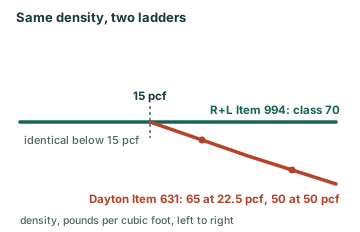
Both documents below are current rules tariffs, not blog summaries. R+L's chart sits in Item 994 and is written for commodities the NMFC lists as exempt. Dayton's chart appears three times in its tariff, in Item 630 (mixed shipments), Item 631 (density does not match the class on the bill of lading) and Item 645 (bill of lading missing a valid NMFC item). The scopes differ, which matters more than the numbers.
| Density (pcf) | R+L Item 994 | Dayton Item 631 |
|---|---|---|
| Less than 1 | 400 | 400 |
| 1 to less than 2 | 300 | 300 |
| 2 to less than 4 | 250 | 250 |
| 4 to less than 6 | 175 | 175 |
| 6 to less than 8 | 125 | 125 |
| 8 to less than 10 | 100 | 100 |
| 10 to less than 12 | 92.5 | 92.5 |
| 12 to less than 15 | 85 | 85 |
| 15 to less than 22.5 | 70 | 70 |
| 22.5 to less than 30 | 70 | 65 |
| 30 to less than 35 | 70 | 60 |
| 35 to less than 50 | 70 | 55 |
| 50 or more | 70 | 50 |
Below 15 pcf the two are identical. Above 15 pcf they cannot both be applied to the same shipment. R+L's scale has no row past 15, so a dense pallet lands on the last row, class 70. Dayton keeps grading, and a 50 pcf pallet is class 50 there. That is a five-step spread between two tariffs a shipper can both be handed in the same week.
What the tariff means by density
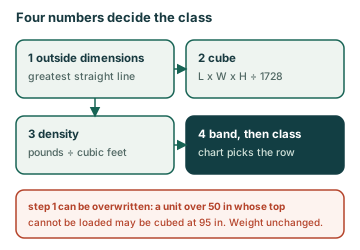
R+L Item 490 is the definition, and it is narrower than most people assume. Cubage is the greatest straight-line length, width and height in inches, including all projections, divided by 1728. Density is weight divided by that cubage, taken on a single handling unit, or on the shipment as a whole when there are several pieces. Two consequences follow for palletized freight: an overhanging carton counts, and a deck board that sticks out past the stringer counts.
The same item then allows the carrier to substitute a dimension it did not measure. Sections 1 to 3 let the carrier apply a vertical dimension of not less than 95 inches to any unit over 50 inches tall on top of which other freight cannot be loaded, and the list of reasons includes palletization in a "pyramided", "rounded off" or "topped off" manner. A unit 70 inches or taller gets the same treatment, and a unit 70 inches or wider can be cubed at 95 inches wide. Section 3 is the limit: those substitutions apply only to shipments physically inspected or verified by dimensioning machinery.
The 95-inch rule, worked on one pallet
Take a 48 by 40 inch pallet, 60 inches tall, 620 pounds gross. Flat top, nothing stacked on it. That is 48 × 40 × 60 ÷ 1728 = 66.7 cubic feet, and 620 ÷ 66.7 = 9.3 pcf. Both charts say class 100.
Now change one fact: the top layer is rounded off, so no other freight can ride on it. The unit is over 50 inches tall, so the carrier may cube it at 95 inches. 48 × 40 × 95 ÷ 1728 = 105.6 cubic feet. The weight has not moved. 620 ÷ 105.6 = 5.9 pcf, which falls in the 4 to less than 6 band. Both charts now say class 175.
| Step | Flat top | Rounded top |
|---|---|---|
| Dimensions used | 48 × 40 × 60 in | 48 × 40 × 95 in |
| Cube | 66.7 ft³ | 105.6 ft³ |
| Density | 9.3 pcf | 5.9 pcf |
| Class on both charts | 100 | 175 |
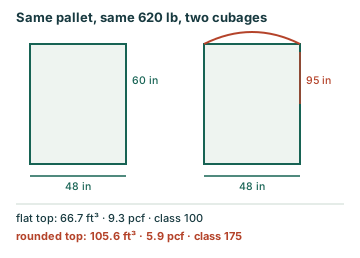
The weight did not change and the pallet did not change. The shape of the load changed the class by 75 points. Anyone quoting from the scale ticket alone is quoting a number the tariff does not use.
Run your own numbers
Enter the dimensions in inches as they would be measured to the outside edge of the load, and the gross weight in pounds including the pallet. The calculator applies both charts and shows where they split.
Two more thresholds worth knowing
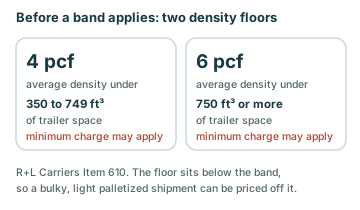
R+L Item 610 attaches a minimum charge to low density freight before any class is applied: shipments averaging under 4 pcf that need at least 350 but less than 749 cubic feet of trailer space, and shipments averaging under 6 pcf that need 750 cubic feet or more. A palletized shipment that is bulky and light can therefore be priced off a minimum charge rather than off the density band, and no chart on this page predicts that outcome.
Dayton's Item 620 is worth reading for a different reason. It is titled artificial calculation of density, and it is cancelled: the practice was removed from the NMFC by the Commodity Classification Standards Board effective August 26, 2019. Tariffs keep dead items in place, so a chart found in a tariff is not automatically a live rule.
What to put in the file
Record four things and the reclassification argument gets shorter: the outside dimensions used for cubage and whether any projection was included; the gross weight and whether the pallet tare is inside it; whether the top could carry other freight; and whether the number came from a tape measure or from a dimensioner. The first two decide the density, the third decides the cubage, and the fourth decides which of the two the carrier will accept.
If the density you computed sits within a few hundredths of a band edge, the rounding question is a separate one, covered in should you round freight density. If the shipment is several pallets, the average is computed over the whole shipment, not per pallet, and the multiple pallet average works that through.
Source scope
R+L Carriers Rules Tariff, effective August 4, 2025: Item 490, density, method of determining, PDF page 33; Item 610, minimum charge for low density freight, PDF page 64; Item 994, classification of exempt commodities, PDF page 128. Document at rl-cdn.com/docs/rlc/rules/rl-rules.pdf.
Dayton Freight Lines Rules Tariff 19-K, effective October 12, 2026: Item 620, PDF page 25; Item 630, mixed shipments, PDF page 25; Item 631, classification density standard, PDF page 26; Item 645, bills of lading non-compliant, PDF page 27. Document at daytonfreight.com/wp-content/uploads/2025/07/DAFG-19-K-27th-Revision-effective-10.12.26.pdf.
Both documents were downloaded and read on 2026-11-01. The bands above are copied, not inferred. No rate, discount or accessorial amount is reproduced here, and nothing on this page states what a shipment will cost.
Not affiliated with R+L Carriers or Dayton Freight Lines. Tariffs change; read the effective copy before relying on a band.