This page uses hypothetical inputs, not measurements from a real shipment. The example isolates the arithmetic so the difference can be reproduced without assuming a commodity classification or a carrier price. Every dimension and weight below is an invented test input labelled hypothetical; every volume, density, total and difference is calculated from those inputs. No freight class is assigned to this example. The question here is what the shipment density actually represents before any classification table is consulted.
Three hypothetical pallets, one combined load
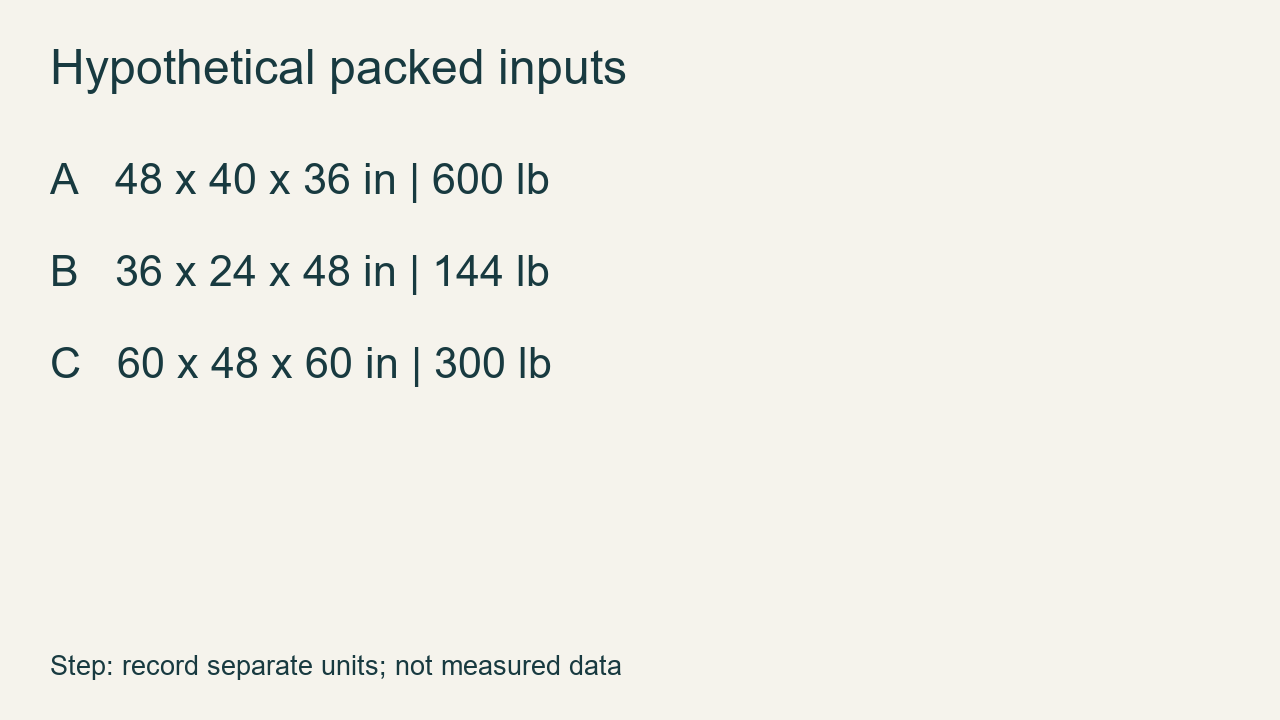
Hypothetical pallet A measures 48 × 40 × 36 inches and weighs 600 pounds packed. Hypothetical pallet B measures 36 × 24 × 48 inches and weighs 144 pounds packed. Hypothetical pallet C measures 60 × 48 × 60 inches and weighs 300 pounds packed. Each weight belongs to the complete packed unit described by the dimensions beside it. These are deliberately different rectangular test units, rather than repeated copies of a single pallet. The labels A, B and C are identifiers for this calculation only.
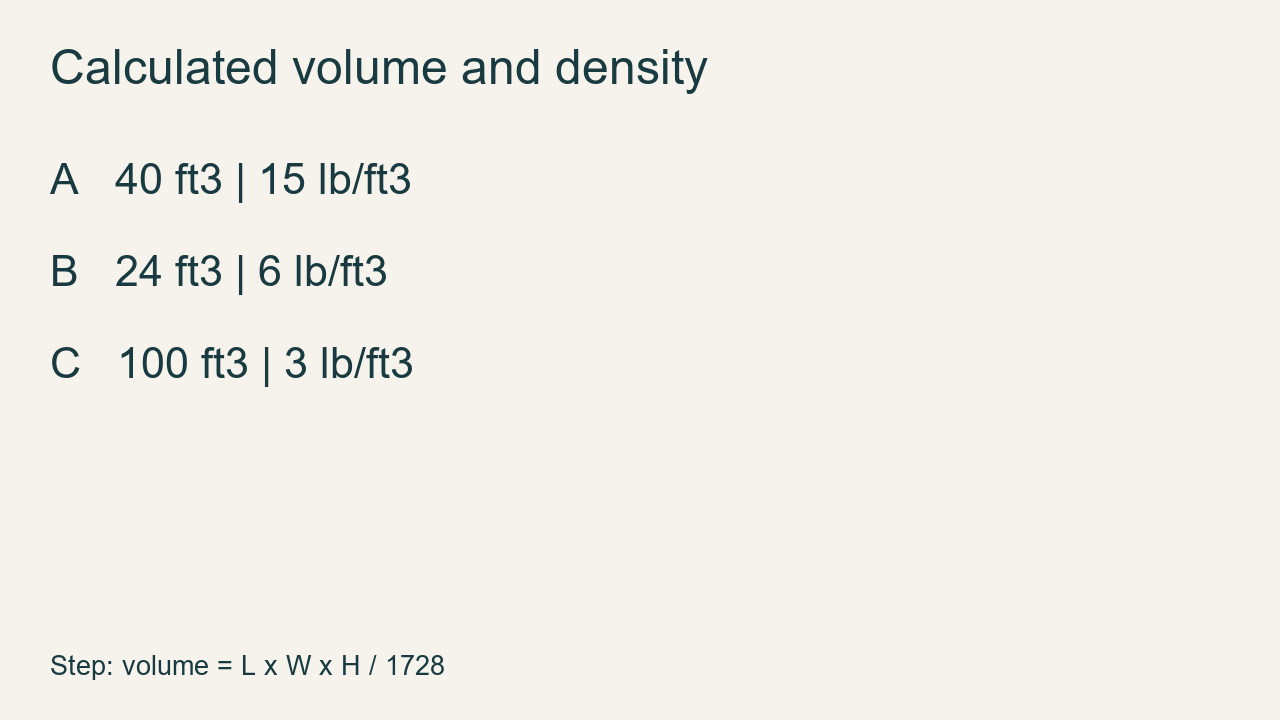
Calculated pallet A volume is 48 × 40 × 36 ÷ 1,728 = 40 cubic feet. Calculated pallet A density is 600 ÷ 40 = 15 pounds per cubic foot. Calculated pallet B volume is 36 × 24 × 48 ÷ 1,728 = 24 cubic feet. Calculated pallet B density is 144 ÷ 24 = 6 pounds per cubic foot. Calculated pallet C volume is 60 × 48 × 60 ÷ 1,728 = 100 cubic feet. Calculated pallet C density is 300 ÷ 100 = 3 pounds per cubic foot. The volume divisor follows from twelve inches per foot in each of the three dimensions: 12 × 12 × 12 = 1,728 cubic inches per cubic foot.
The video explains the hypothetical calculation above.
The two answers side by side
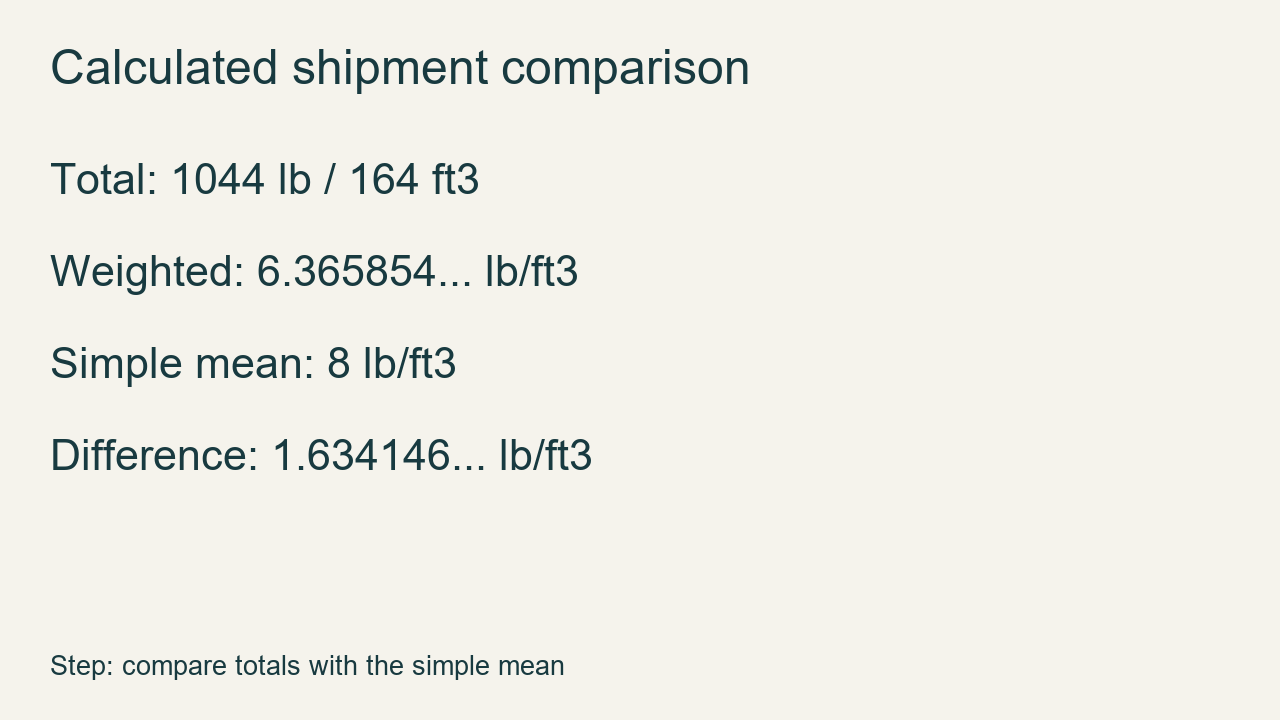
The calculated combined weight is 600 + 144 + 300 = 1,044 pounds. The calculated combined volume is 40 + 24 + 100 = 164 cubic feet. Dividing these totals gives 1,044 ÷ 164 = 261/41 pounds per cubic foot. That calculated density is approximately 6.365854 pounds per cubic foot, displayed here as 6.37. The displayed rounding is a presentation choice, not an extra measurement. All later comparisons retain the exact fraction until their final display.
The calculated simple average instead adds the individual densities: (15 + 6 + 3) ÷ 3 = 8 pounds per cubic foot. It exceeds the combined result by 8 − 261/41 = 67/41 pounds per cubic foot. The calculated difference is approximately 1.634146 pounds per cubic foot, displayed as 1.63. Both methods use the same hypothetical inputs, so this disagreement cannot be attributed to a changed weight or a changed measurement. It comes entirely from giving equal influence to unequal volumes.
What the simple average silently changes
In the simple average, hypothetical A, B and C each contribute one third of the answer. In the volume-weighted calculation, their calculated shares are 40/164, 24/164 and 100/164 respectively. Those shares are also 10/41, 6/41 and 25/41. The biggest unit therefore contributes the largest volume share even though its density is the smallest of the three. Counting handling units does not describe how much space each unit occupies. A pallet label is not a unit of volume.
The weighted calculation can be checked without adding dimensions again: (15 × 40 + 6 × 24 + 3 × 100) ÷ 164. Its calculated numerator is 600 + 144 + 300, which recovers the entered packed weights. Its calculated answer is again 1,044/164 pounds per cubic foot. This agreement is the useful cross-check: each density is multiplied by the volume from which that density was calculated. Multiplying by the pallet count instead would not recover those weights. The weights and volumes must remain paired.
For the existing input interface, open the freight density calculator for separately measured pallets. Enter the complete unit in each row rather than a shipment-wide average height. That tool and this worked example answer different reading needs: the tool runs your inputs, while this page explains why one aggregation method preserves the shipment totals. A combined density is not permission to combine commodity classifications that must remain separate.
A second grouping exposes the error
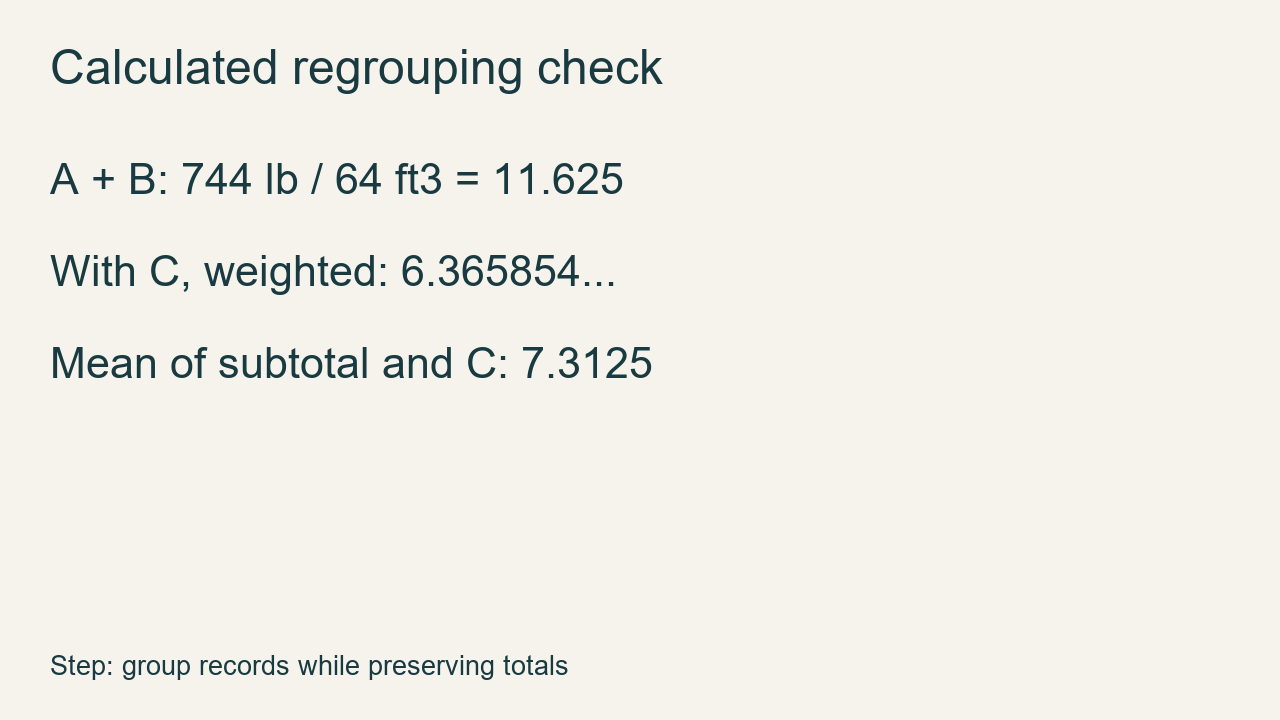
Keep all three hypothetical units unchanged, but calculate the A-and-B subtotal first. Its calculated weight is 600 + 144 = 744 pounds and its calculated volume is 40 + 24 = 64 cubic feet. The calculated subtotal density is 744 ÷ 64 = 11.625 pounds per cubic foot. Combining that subtotal with C by their volumes gives (11.625 × 64 + 3 × 100) ÷ 164 = 261/41. The final calculated density has not changed because neither total has changed. Grouping the records differently does not change the packed load.
Simply averaging the subtotal density with C instead gives (11.625 + 3) ÷ 2 = 7.3125 pounds per cubic foot. That is different from both the correct combined result and the earlier simple average of 8. The same hypothetical shipment would acquire different answers depending on which rows were grouped first. A shipment-wide density should not depend on how a spreadsheet happens to group its records. Keeping the subtotals in pounds and cubic feet avoids that grouping problem.
When an ordinary average happens to agree
Equal volumes remove the weighting difference, but equal pallet counts do not establish equal volumes. As a separate hypothetical control, keep densities of 15, 6 and 3 pounds per cubic foot and give each unit 40 cubic feet. The calculated weights required by that control are 600, 240 and 120 pounds. Its calculated total is 960 pounds over 120 cubic feet, which equals 8 pounds per cubic foot. The ordinary average also gives 8 in this control because every volume share is identical. These control weights are newly derived hypothetical values, not corrections to pallets B and C in the main example.
Returning to the original example restores the unequal volumes of 40, 24 and 100 cubic feet. Its calculated weight remains 1,044 pounds and its calculated density remains 261/41. A spreadsheet that averages the density column cannot tell whether it is operating on the equal-volume control or the unequal-volume load. It needs the volume column to distinguish them. Agreement on an equal-volume test alone therefore does not validate an aggregation formula for differently sized units.
Preserve units and the meaning of the result
The conversion used here starts with inches and ends with cubic feet; the density numerator remains pounds. Divide pounds by cubic feet and the result is pounds per cubic foot. Reversing that division produces cubic feet per pound, a different quantity that must not be labelled density. If your original measurements use another unit system, the cargo density calculator with unit conversion provides a separate input route. Convert consistently before comparing two displayed answers, and keep the original measurements available beside the conversion.
The freight class chart with explicit density intervals is a separate reference after the density calculation. This example deliberately stops short of claiming that its aggregate selects a valid commodity item or establishes an invoice amount. Dimensions and weights alone do not identify the goods. Likewise, a lower calculated density is not evidence of a particular carrier surcharge. Those questions require their own applicable records rather than an extra assumption hidden inside an average.
Keep the scope of the totals explicit when transferring this calculation into a booking record. A combined figure can refer to the packed handling units entered here, while another figure may refer to a different grouping or a different packing state. Matching the word density on two screens does not establish that their denominators describe the same volume. The arithmetic is reproducible only when the underlying dimension records remain attached to the result.
There is also a distinction between correcting a record and changing the aggregation method. If a packed dimension was entered incorrectly, the affected unit's volume needs to be recalculated before the totals are formed. If the inputs are unchanged but a density average is replaced with total weight divided by total volume, the correction is to the formula. Preserve that distinction when explaining why an answer changed: this example demonstrates a formula difference and makes no claim that anyone measured a real pallet incorrectly.
Questions about the worked example
Can I average the three displayed density values?
For hypothetical A, B and C, averaging the displayed values gives exactly 8, while the totals give 261/41. In this case the error exists even before rounding because the individual densities are already exact integers. Rounding is therefore not the cause of this particular difference. Use the totals if the question is the density of the combined packed volume represented by these records.
Does the combined figure describe every pallet?
No: calculated densities remain 15 for A, 6 for B and 3 for C. The combined 261/41 describes the aggregate only. Retaining the separate results shows how that aggregate was formed without pretending the individual units have become physically identical. It also prevents the combined number from replacing the original evidence when a question concerns only one handling unit.
Can the arithmetic be reproduced without a calculator interface?
Yes: the hypothetical dimension products are 69,120, 41,472 and 172,800 cubic inches. Dividing each by 1,728 gives the same calculated volumes of 40, 24 and 100 cubic feet. Their sum is 164, and the entered hypothetical weights sum to 1,044. Dividing those two totals reproduces 261/41; averaging the separate density outputs reproduces 8. These are calculated checks on stated hypothetical inputs, not observations of a shipment or results from a carrier inspection.