Should You Round Freight Density Before Choosing a Class?
Keep the calculated density unrounded when comparing it with a density band. Round the displayed result only after the comparison. For example, 9.9998 lb/ft³ displays as 10.00, but remains below 10. Confirm the applicable NMFC item and any carrier measurement rules before using a density-based class.
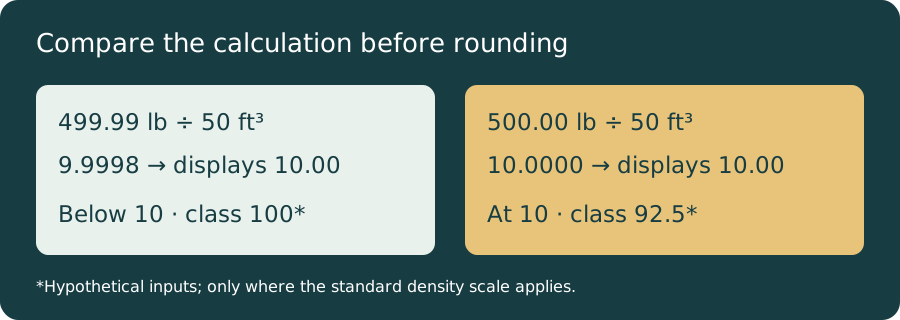
One displayed number, two different answers
Consider a deliberately constructed handling unit measuring 48 × 40 × 45 inches. Its volume is exactly 50 cubic feet: 48 × 40 × 45 ÷ 1,728 = 50. All weights below are synthetic arithmetic inputs. They are not measured loads, scale-accuracy claims, or carrier quotations.
At 499.99 lb, dividing by 50 gives 9.9998 lb/ft³. A two-decimal display reads 10.00. Comparing that display with a 10 lb/ft³ boundary would move the example across the boundary even though its input has not changed. At 500.00 lb, the same calculation gives exactly 10. The visual display is identical, but the mathematical comparison is different.
| Weight at 50 ft³ | Calculated density | 2-decimal display | Band-based class |
|---|---|---|---|
| 499.99 lb | 9.9998 | 10.00 | 100 |
| 500.00 lb | 10.0000 | 10.00 | 92.5 |
| 599.99 lb | 11.9998 | 12.00 | 92.5 |
| 600.00 lb | 12.0000 | 12.00 | 85 |
The last two rows repeat the experiment at the next boundary. They show why adding more printed decimal places is an incomplete fix: a sufficiently close input can still round across the cutoff. The decision should use the calculation, rather than the text prepared for display.
A boundary check you can reproduce
For this 50 ft³ example, multiply the boundary density by 50 to find the boundary weight. The 10 lb/ft³ cutoff is 500 lb; the 12 lb/ft³ cutoff is 600 lb; and the 15 lb/ft³ cutoff is 750 lb. This gives an independent check without dividing a rounded density again.
For a different package, keep its actual volume in the comparison. With weight W, volume V, and boundary B, compare W with B × V. Do not replace V with a rounded screen value first. This algebraic check is an arithmetic diagnostic, not permission to change the measured weight, dimensions, or a carrier's required measurement convention.
What to record when a result is close
Save the packed length, width, height, total weight, units, and the source of those measurements. Record the volume calculation and the density before display formatting. Add the applicable NMFC item and the classification source used. A screenshot showing only “10.00” cannot distinguish our first two rows; the input record can.
If your measurements are only approximate, extra digits in the output do not make them more accurate. Recheck the load and the carrier's rules. Do not add a tiny weight adjustment or shorten a dimension merely to obtain a preferred band. Our hundredth-pound differences were chosen to expose the software issue, not as a practical loading strategy.
Where the classification limits come from
The public standard density scale lists 8 to less than 10 as class 100, 10 to less than 12 as class 92.5, and 12 to less than 15 as class 85. These bands apply when the commodity's governing classification uses that scale. Density alone does not identify the correct NMFC item.
NMFTA's measurement guidance uses the complete handling unit as offered for shipment. Include packaging and projections in its outside dimensions, and include the shipped unit's total weight. A carrier can check the measurements after pickup. Follow the applicable tariff and item provisions when they prescribe a different treatment.
Quick questions
Is 10.00 always class 92.5?
No. First determine whether 10.00 is an exact calculation or a formatted display. Then confirm that the standard density scale applies to the commodity.
Should I round the package dimensions down?
No. Use the carrier's required measurement method for the finished load. Display rounding of a calculated ratio is a separate issue.
Does a lower numerical class guarantee a cheaper quote?
No. Obtain the actual quote with the correct shipment information; a density band is not a freight price.
Calculate freight density · Check the standard density chart
Sources and method
Checked October 19, 2026. NMFTA: density scale and measurement pitfalls; NMFTA: handling-unit density calculation; Estes: density calculator and classification factors. The four-row comparison, boundary-weight check, and audit-record discussion are original constructed analysis, not freight tests.