Why Do Freight Class Calculators Show Different Results?
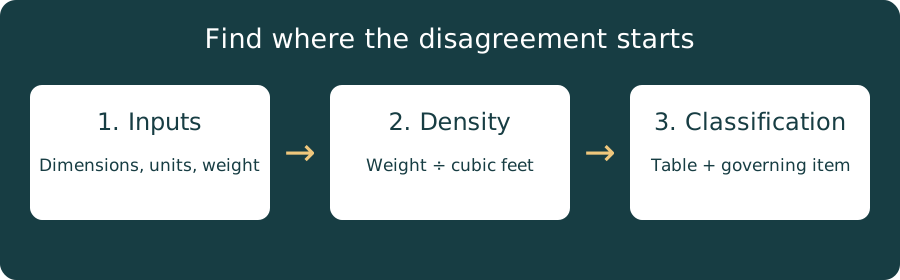
Compare the inputs, the density calculation, and the classification table separately. Two tools can calculate the same density yet suggest different classes because their tables differ. Neither result establishes the correct commodity classification by itself. Confirm the applicable NMFC item before booking.
A controlled comparison with one hypothetical pallet
Our constructed pallet measures 48 × 40 × 36 inches including its packaging. That gives 69,120 cubic inches, or exactly 40 cubic feet after division by 1,728. Hold that volume constant and change only the weight. The following calculations are synthetic examples. We have not entered them into either website's interactive calculator or shipped these loads.
| Weight | Density: weight ÷ 40 | FreightClassCalc chart | Estes 13-band chart |
|---|---|---|---|
| 180 lb | 4.5 lb/ft³ | 200 | 175 |
| 260 lb | 6.5 lb/ft³ | 150 | 125 |
| 340 lb | 8.5 lb/ft³ | 110 | 100 |
Each row has exactly one density. The disagreement appears only after looking up that density. Reweighing the hypothetical pallet would therefore miss the cause of this particular discrepancy. Likewise, changing the weight until the two outputs agree would destroy the controlled comparison and would not validate a shipment.
Notice that none of our examples sits on a class boundary. We deliberately chose middle-of-band densities to separate a table difference from a rounding issue. To reproduce this diagnostic, save each chart's URL and access date beside the inputs. A screenshot of the final class without its source table loses the evidence needed to explain the difference.
Use a three-column audit before changing anything
Make a small record with columns for Tool A, Tool B, and your independent arithmetic. In the first row, write the units and the complete packed dimensions. In the second, write the total handling-unit weight and quantity. In the third, record cube and density. Only then add a row for the stated chart, effective date, and applicable commodity provision.
If cube differs, investigate dimensions, units, or quantity treatment first. If cube agrees but density differs, investigate weight and whether a field means weight per unit or total weight. If both agree but class differs, inspect the lookup table and item applicability. This order narrows the question without assuming that the lower numerical class is right.
For example, entering our 260 lb load as 260 kilograms would describe a different load, not a competing classification opinion. Leaving the pallet out of the 36-inch packed height would change the denominator. A chart comparison is meaningful only after the physical description matches. Keep the original measurements intact while troubleshooting.
Why the table's scope matters
NMFTA announced a July 19, 2025 change from an 11-sub density scale to a 13-sub scale and movement of many items to density-based classification. That announcement also distinguishes items with special handling, stowability, or liability considerations. It does not say every commodity can be classified using one generic density chart.
The public FreightClassCalc information page and Estes chart display different bands in the examples above. This observation establishes a chart mismatch, not the reason either website chose its table. Estes labels its displayed chart as updated in July 2025 and notes that some commodities can have different densities for a given class. Confirm the current governing item and carrier requirements instead of choosing a chart solely by appearance.
Questions to resolve before booking
Which calculator should I trust?
First verify the arithmetic independently. Then verify the classification against the applicable commodity item and shipment requirements. Agreement between two generic tools is not proof of applicability.
Does the lowest class mean the best price?
A class estimate is not a quote. Request pricing for the accurate shipment description rather than editing inputs to obtain a preferred class.
What should I send when asking about a discrepancy?
Send packed dimensions, units, total weight, quantity, the two source URLs, both density results, and the proposed NMFC item. Ask which provision governs this shipment.
Check your freight density · Separate display rounding from classification
Sources and method
- FreightClassCalc: Freight Info — publicly displayed comparison chart.
- Estes: Class and Density Calculator — publicly displayed 13-band chart and applicability notes.
- NMFTA: How Shippers Can Prepare for the 2025 NMFC Changes — classification transition and item considerations.
Sources checked October 20, 2026. Examples and the audit sequence are our original constructed analysis; no live calculator performance or freight measurements are claimed.