Why the answer is a minimum, not a sum
Two separate ceilings apply to the same trailer, and a pallet has to pass both. The floor ceiling is geometry: how many footprints fit inside the walls. The weight ceiling is the gross limit minus what the rig already weighs, divided by what one pallet weighs. Multiply nothing, add nothing — take the smaller figure.
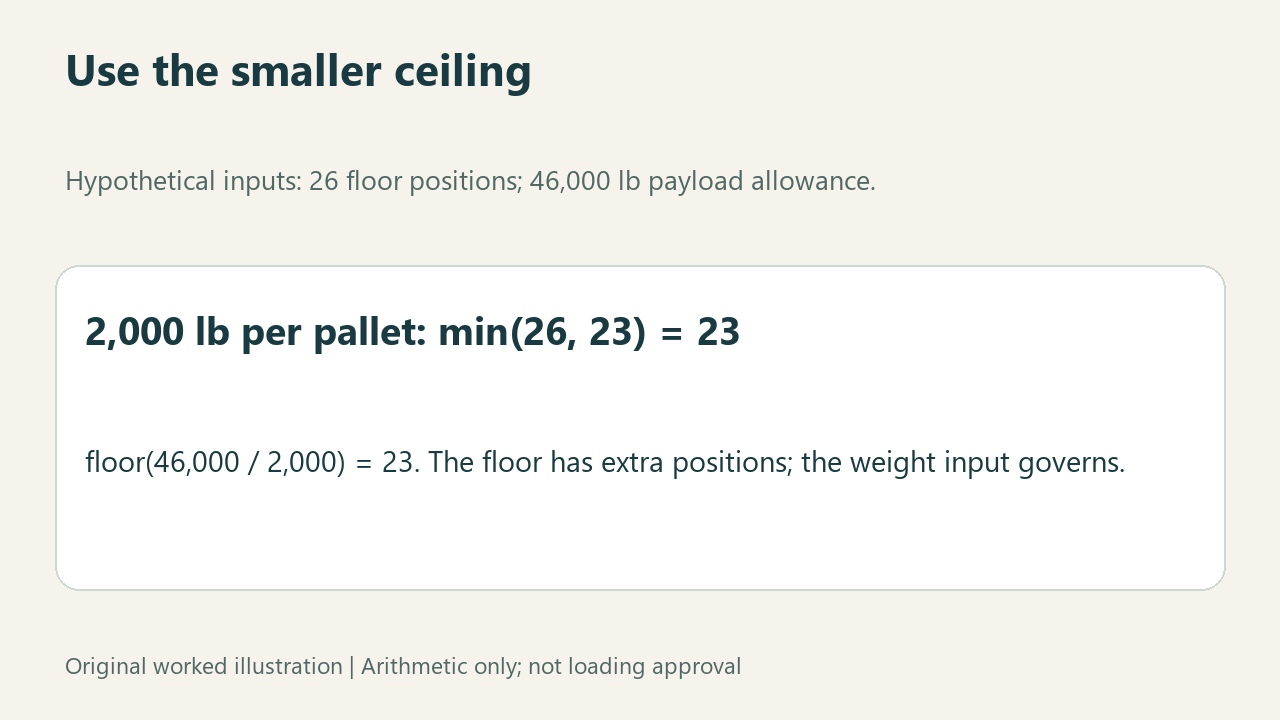
The reason people overestimate is that the two ceilings get computed on different days. Someone counts 26 positions from a layout drawing, then separately confirms the truck is legal at 80,000 lb, and treats both as approvals. They are not. At 2,000 lb gross per pallet, 26 pallets weigh 52,000 lb, and the same rig that is legal at 46,000 lb of payload is now 6,000 lb over. The floor was never the binding constraint at that weight; it only looked like it because it was the number someone had drawn.
| Gross lb each | 46,000 ÷ lb | Weight ceiling | Floor positions | Pallets to load | What stopped you |
|---|---|---|---|---|---|
| 500 | 92.00 | 92 | 26 | 26 | Floor |
| 800 | 57.50 | 57 | 26 | 26 | Floor |
| 1,200 | 38.33 | 38 | 26 | 26 | Floor |
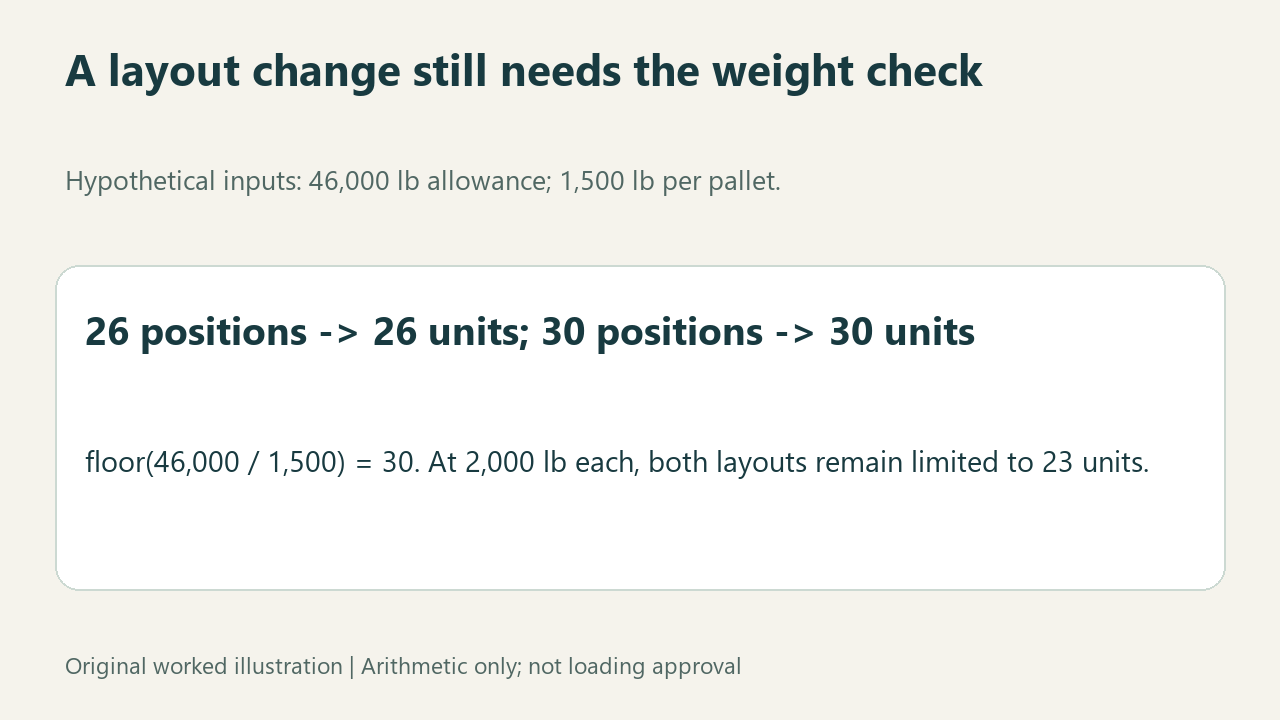
| 1,500 | 30.67 | 30 | 26 | 26 | Floor |
| 1,769 | 26.00 | 26 | 26 | 26 | Neither — the tie |
| 2,000 | 23.00 | 23 | 26 | 23 | Weight |
| 2,500 | 18.40 | 18 | 26 | 18 | Weight |
| 3,000 | 15.33 | 15 | 26 | 15 | Weight |
Read the 1,500 lb row carefully, because it is the one that catches estimators out. The weight ceiling is 30, which is higher than the floor, so the floor governs and the answer stays 26. A spreadsheet that takes the weight ceiling as the answer would promise 30 pallets in a trailer that holds 26. That is the failure mode this page exists to prevent, and it happens on every load light enough to be cube-bound.
The crossover moves with the empty weight and with the layout
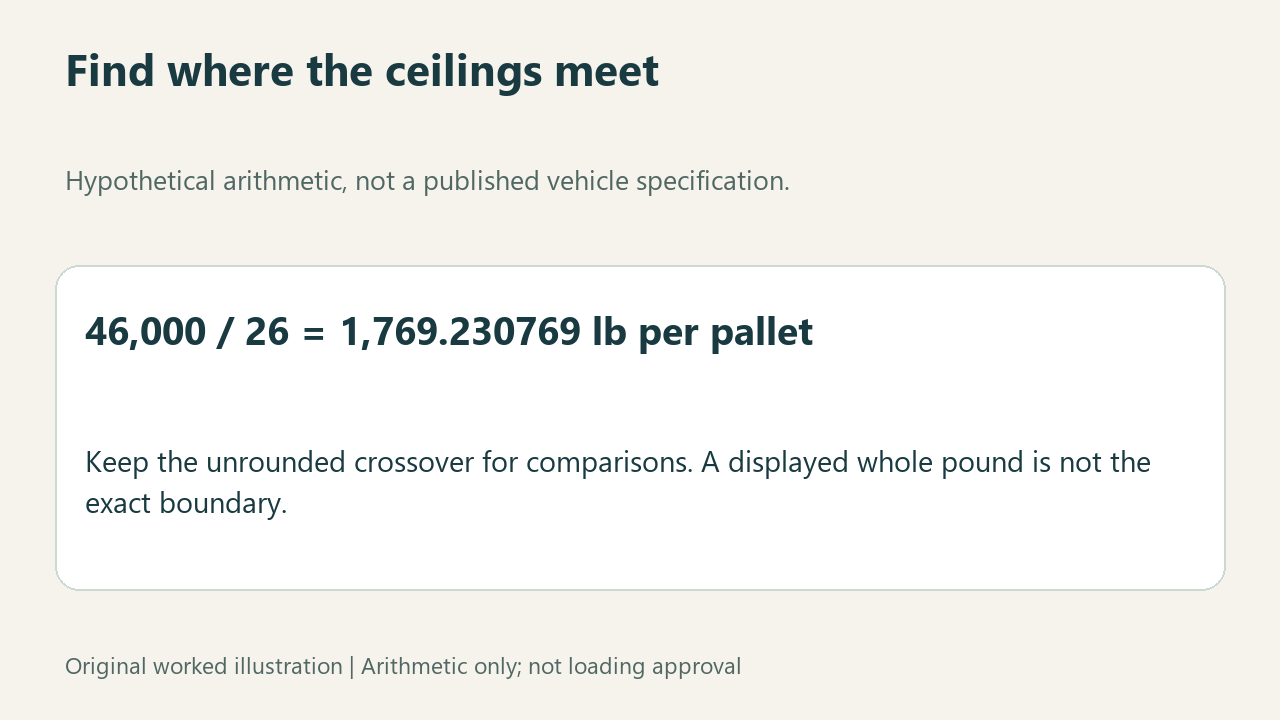
The crossover is the per-pallet weight at which the two ceilings meet: payload divided by floor positions. It is the single most useful number in an estimate, because it tells you which question to ask next. Below it, go measure the trailer. Above it, go find the scale ticket and the axle weights.
| Empty weight | Payload | 26 positions | 30 positions |
|---|---|---|---|
| 32,000 lb | 48,000 lb | 1,846 lb | 1,600 lb |
| 34,000 lb | 46,000 lb | 1,769 lb | 1,533 lb |
| 36,000 lb | 44,000 lb | 1,692 lb | 1,467 lb |
Two thousand pounds of empty weight moves the crossover by 77 lb per pallet at 26 positions. That is small against a 1,200 lb pallet and decisive against a 1,800 lb one, which is exactly where most dense freight sits. Use the weight on the door jamb sticker or the registration, not a number from a forum: tractor spec, fuel level, APU, chains and the driver's kit all move it, and the estimate inherits every one of those pounds.
The 30-position column is the turned layout, where the 40 inch side runs along the trailer. It lowers the crossover because more pallets share the same payload. Turning the pallet buys floor and costs weight headroom at the same time, so a layout change is never free — it is a trade between the two ceilings, and the trade only pays if your pallets are light.
80,000 lb is a ceiling most loads never reach
The gross limit is the number everyone quotes and the one that usually gets checked last. Federal law caps gross vehicle weight at 80,000 lb, a single axle at 20,000 lb and a tandem at 34,000 lb, and on top of those caps the Bridge Formula limits any group of consecutive axles by the distance between the outer axles of that group. The formula is W = 500 × (LN ÷ (N − 1) + 12N + 36), with L in feet and N the axle count in the group.
Run the standard five-axle combination through it and the arithmetic produces a number worth memorising: 80,000 lb on five axles requires 51 feet between the steer axle and the trailer's rear axle. At 48 feet the same five axles are limited to 78,000 lb, at 50 feet to 79,000 lb. A 53 ft trailer does not guarantee a 51 ft wheelbase — the tractor's wheelbase and the kingpin setting decide that, and a short tractor with a deep kingpin can put a legal-looking load over the limit before a single pallet is refused.
| Axles in group | Span | Maximum group weight |
|---|---|---|
| 5 | 48 ft | 78,000 lb |
| 5 | 50 ft | 79,000 lb |
| 5 | 51 ft | 80,000 lb |
| 4 | 34 ft | 64,500 lb |
| 4 | 35 ft | 65,500 lb |
| 4 | 36 ft | 66,000 lb |
| 4 | 37 ft | 66,500 lb |
| 4 | 38 ft | 67,500 lb |
| 4 | 39 ft | 68,000 lb |
That four-axle block is the one that bites a loaded van. The drive tandem and the trailer tandem together are four consecutive axles, and at 34,000 lb each they add to 68,000 lb. Look down the table: 68,000 lb on four axles needs a 39 ft span. The Federal Highway Administration's own worked example puts the figure at 35 ft and 65,500 lb against an actual 68,000 lb, and calls it a violation.
For an estimate, this converts into a rule with a number attached. Measure from the centre of the tractor's forward drive axle to the centre of the trailer's rear axle. If that span is 36 feet or more, the tandem pair can legally carry 68,000 lb and the gross ceiling is what limits you. If it is under 36 feet, cap the pair at the table value for that span — 65,500 lb at 35 feet, which is 2,500 lb less than the pair can otherwise carry. At 1,200 lb gross per pallet, 2,500 lb is two pallets, and two pallets is the difference between an estimate that holds at the scale and one that does not.
Read the estimate against the scale ticket in this order
A scale ticket prints axle weights in a fixed order, and checking them in the wrong order wastes the trip. Work down the list, stopping at the first failure.
| Step | Check | Limit |
|---|---|---|
| 1 | Steer axle | 20,000 lb, and often less by the tyre rating on the front axle |
| 2 | Drive tandem | 34,000 lb |
| 3 | Trailer tandem | 34,000 lb |
| 4 | Drive tandem plus trailer tandem, against the span between them | the four-axle row above for that span |
| 5 | Gross, against the span from steer axle to trailer rear axle | the five-axle row above for that span, capped at 80,000 lb |
| 6 | The trailer's own rating plate | whichever is lower, the plate or the highway limit |
Step 4 is the step that gets skipped, and it is the one that fails on a van with the tandems slid forward. Steps 1 through 3 can all pass, step 5 can pass at 78,000 lb gross, and step 4 can still be over because the pair is capped at 65,500 lb by a 35 ft span. A ticket showing three compliant lines is not a compliant truck.
Step 6 is the quiet one. A trailer's rating plate states the maximum loaded weight the equipment is built for, and that rating can sit below the highway ceiling. The lower of the two governs, so photograph the plate once and keep the number with the estimate instead of rediscovering it at a customer's dock.
What this estimator leaves out
- Pinwheel and mixed-row layouts, which can add positions on some pallet sizes and are covered on the 48 × 40 layout page with coordinates.
- Stacking. A second tier doubles the count on paper and is limited by the bottom pallet's dynamic rating and the load's crush resistance, not by the floor.
- Overhang. A load wider than the pallet eats the gap between rows, and a load past the stringer changes both the footprint and the securement.
- Load distribution. Where the weight sits decides the axle split, and this page assumes you will confirm that at a scale rather than on paper.
- State grandfather rights and permit weights, which can be higher than the federal figures on some routes and are not portable between states.
- Anything that moves in transit — liquid, hanging, or unsecured loads — where the static count is not the operative limit.
None of those omissions makes the arithmetic wrong. They make the estimate a starting point with a named boundary, which is more useful than a single confident number that turns out to have assumed the load was perfectly centred and the tandems were in the right hole.
Questions the estimate raises
Should I include the pallet when measuring my shipment?
Yes. Use the finished handling unit's outside dimensions and gross weight, including its pallet and packaging, for the density record. XPO measuring tips explicitly includes the pallet, and NMFTA's density guidance uses the handling unit as tendered. Sources checked November 4, 2026. A geometric floor count does not provide those measurements.
Does the pallet's own weight count against the ceiling?
Yes. The 1,769 lb crossover is gross weight per pallet, so a 40 lb pallet under 1,729 lb of goods is at the crossover, not below it. On a light load the pallet itself is a visible share of the payload; on a 2,500 lb pallet it is noise.
Why did my count drop when I only moved the tandems?
Because moving them changes the span between the drive tandem and the trailer tandem, and that span sets the four-axle limit. Sliding the tandems forward can drop the span under 36 feet, which takes the pair from 68,000 lb to a table value near 65,500 lb without changing the load by a pound.
Can I just load 26 pallets at 2,000 lb each?
No. That is 52,000 lb of payload against 46,000 lb available at a 34,000 lb empty weight, so the rig is 6,000 lb over gross before any axle is considered. The estimate for that pallet is 23, and the floor's 26 is the number that was never available.
Sources checked November 4, 2026: gross, single-axle and tandem-axle limits and the Bridge Formula as published by the Federal Highway Administration in Bridge Formula Weights (FHWA-HOP-19-028, August 2019), which paraphrases 23 U.S.C. 127 and 23 C.F.R. 658, including the tandem-pair exception at 36 feet; inside width of 101 inches and the 110½ inch door opening as listed by Utility Trailer for the 4000D-X Composite. Inside length is an input on this page, defaulted to 630 inches (52 ft 6 in); measure your own trailer, because the model and spec level change it. The empty weight is an input, not a published figure.