First separate a request from required service
The retrieved versions are effective May 25, 2020 and October 3, 2022, returned for inquiries dated December 31, 2020 and December 31, 2023 respectively. Both describe requested-but-unperformed service separately from unrequested service that was required to complete the pickup or delivery. These are historical public rule texts, retrieved October 23, 2026, not current quotes or proof that either version governed your shipment.
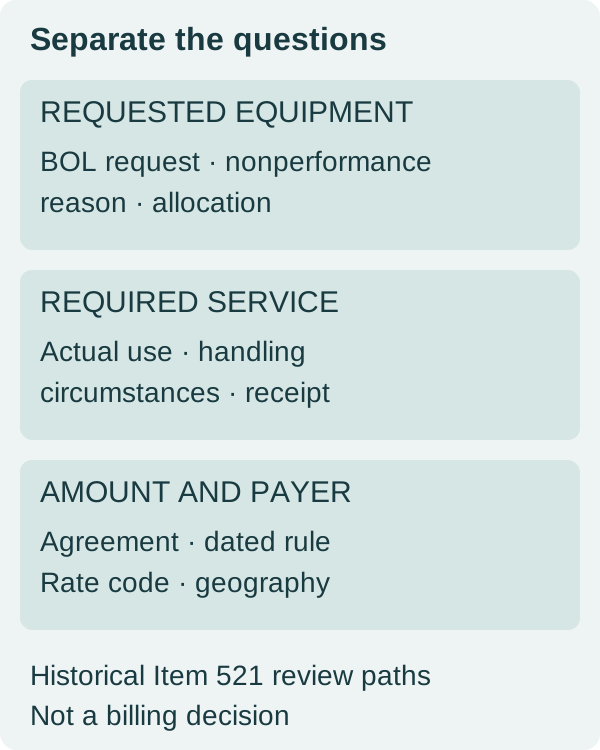
| Review path | Source condition | Records to compare |
|---|---|---|
| Requested, not performed | Request present on BOL; nonperformance through no fault of the carrier; specialized equipment allocated | Original BOL, accepted corrections, explanation of nonperformance and allocation |
| Not requested, but required | Service used when no dock or forklift was readily available and the piece could not be handled safely and damage free | Delivery record, handling circumstances, applicable rule version |
| Amount and payer | Applicable freight terms, rate code, location scope and pricing agreement | Invoice line, governing agreement and dated tariff |
If the BOL request is missing and the platform was not used, neither branch summarized here has been established by those two facts alone. If a request exists but the reason for nonperformance is unrecorded, the carrier-fault condition remains unanswered even when the invoice names liftgate service.
Do not alter freight dimensions or a density-based class estimate to make an accessorial line disappear. A freight class calculator addresses a different part of the shipment record from the request for special equipment.
What changed between the two rule texts?
Both retrieved versions retain the requested-but-unused equipment provision. A changed dollar table and an unchanged unused-equipment clause are separate findings, so a rate increase cannot by itself establish a new reason for charging.
For these two versions, the unused-service test stays recognizable while the payment reference moves from terms for this specific service to terms applied to the shipment. That wording change belongs in the payer column of a historical review, not in the column recording whether the platform moved.
| Field | Effective May 25, 2020 | Effective October 3, 2022 |
|---|---|---|
| Per CWT | $7.52 | $7.95 |
| Minimum per service | $149.00 | $158.00 |
| Maximum per service | $350.00 | $370.00 |
| Table 1 geography | Specified New York and Washington-area postal ranges excluded; separate Table 2 | All points to all points |
| Other rate codes | Additional code rows also present | Additional code rows also present |
The earlier Table 1 exclusions and later all-points label prevent the two WOINET rows from proving a uniform nationwide increase. The presence of other rate codes in both tables means the displayed WOINET minimum is not a universal minimum for every account.
A review that copies only the newer prices into the older payment wording combines separate versions and cannot establish the source of either the payer or the amount. A matching item number without a matched effective date and rate code is insufficient to reproduce either historical line.
Both texts also allow an adjustment reflecting equipment or service costs when equipment is rented or outsourced. The figures above therefore cannot replace the applicable agreement and the full charging provisions.
A receipt difference worth recording
The 2020 text expressly describes a driver checkbox or delivery-receipt notation when required service was not already indicated on the receipt. The retrieved 2022 text does not repeat that paragraph. Its absence is a difference between these two texts, not evidence that receipt records became irrelevant or that another provision could not require them.
An empty receipt therefore belongs beside the version-specific requirement, rather than being treated as cancellation of the separate requested-but-unused clause.
Build a review record without filling the gaps yourself
Collect the invoice line, original BOL, any accepted correction, delivery receipt, governing pricing reference and the explanation of why service was not performed. A photograph of a dock can describe the location, but it cannot date a BOL amendment or establish why allocated equipment went unused.
Keep the BOL-request time and any accepted correction time next to the equipment-allocation explanation, because those records address different parts of the stated condition. Use separate review outcomes for request not evidenced, reason not evidenced and amount not reconciled; otherwise one missing record can be mistaken for agreement with the whole charge.
This is a suggested record structure, not a carrier claim form, a cancellation deadline or a promise of a refund. Leave an unknown field unresolved instead of substituting a preferred answer.
| Field | What to record |
|---|---|
| Governing text | Agreement, tariff item, effective date, applicable exception |
| Request | BOL request and any accepted correction with dates |
| Nonperformance | What happened, who recorded it, and the reason given |
| Allocation | Explanation or record supporting the allocated-equipment assertion |
| Amount | Rate code, geography, payer terms and invoice calculation |
| Open issue | Missing request evidence, missing reason, or unreconciled amount |
Questions about unused liftgate charges
Does no liftgate movement automatically mean no charge?
No: the historical requested-equipment provision can address allocated equipment even when service was not performed, subject to its stated conditions and the governing agreement.
Can I use these dollar amounts for a shipment today?
No: the table documents two dated YRC texts, not a current carrier quote, an account-specific price or a universal liftgate fee.
Is this a freight-class correction?
Not by itself: a dispute about the equipment request, performance or payer is separate from a dispute about commodity classification or measured density.
I compare a different location-based fee in inside delivery minimums by ZIP, where the service location selects the applicable charging branch.
Sources and related tools
The comparison uses the official public YRC Tariff 100 Item 521 date-query responses linked below, with effective dates retained separately from inquiry and retrieval dates. No archived snapshot, customer invoice, actual disputed shipment or refund outcome was used.
- YRC Item 521: inquiry December 31, 2020; effective May 25, 2020
- YRC Item 521: inquiry December 31, 2023; effective October 3, 2022
For a separate rating question, use the NMFC and density classification calculator or read the dated cubic-capacity minimum-charge comparison.