One item number, two dated instructions
Keep three dates separate when using this example: the date requested from the carrier's lookup, the effective date printed on the returned rule, and the date you retrieved it. A request for December 2023 returned a September 2021 rule. That does not make it a rule issued in 2023. Neither lookup is an archived snapshot, and neither proves which terms governed a particular customer's shipment. The comparison below is between two retrieved rule texts, not two documented customer invoices.
| Source field | Effective February 19, 2018 | Effective September 1, 2021 |
|---|---|---|
| Lookup date requested | December 31, 2020 | December 31, 2023 |
| Stated trigger | 750 cubic feet or more, with average density below 6 lb/ft³ | 750 cubic feet or more, with average density below 6 lb/ft³ |
| Minimum-charge method | Mileage tables and item-specific discounts, subject to charge floors | Customer pricing excluding FAK, rated at Class 150 with calculated weight at 6 lb/ft³ |
| Two earlier floor bands | 750 to less than 1,100 ft³: $938 floor; 1,100 to less than 1,600 ft³: $1,139 floor | Do not import the earlier floors into this version's rating instruction |
| Cube on the freight bill | Total cube used for the minimum shipment charge must be indicated | Total cube used for the minimum shipment charge must be indicated |
The earlier floors are not a complete stand-alone price list: the document also supplies mileage tables and discounts. The later document's rule uses customer pricing, so the public item alone does not provide a complete dollar quote. Read the source's application and non-application provisions before using either method in a historical comparison.
Read the carrier lookup returning the February 2018 text · Read the carrier lookup returning the September 2021 text
Why the calculator result can be right while the comparison is wrong
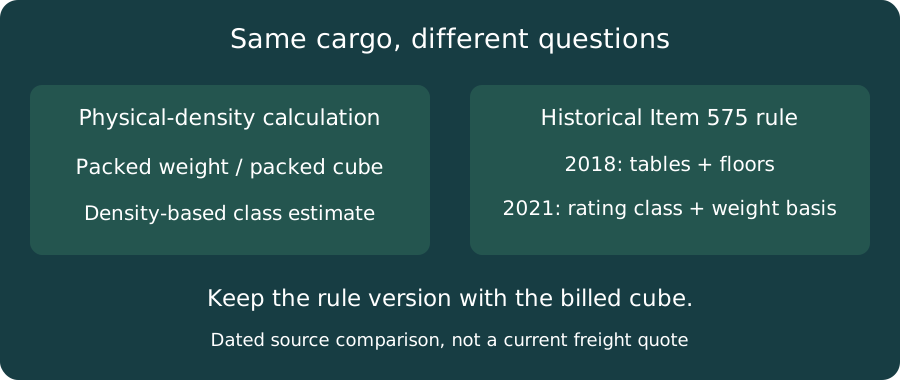
The important change is what the rule tells the rating process to do. The earlier text points to mileage tables, item-specific discounts and minimum-charge floors. The later text names a rating class and a calculated weight. Those are different instructions, even though the item number and density trigger remain recognizable. A calculator could reproduce the measured density perfectly and still omit the rating instruction that determines the minimum charge. Treating that difference as a broken density formula sends the review toward the wrong question.
Do not carry the earlier dollar floor into the later class-and-weight instruction and call the combination a carrier rule. That would manufacture a third version that neither source contains. Likewise, the later reference to Class 150 is a rating instruction within that item; it is not permission to replace every low-density commodity classification with 150. Keep the measured shipment, the applicable commodity classification and the minimum-charge rating basis as separate entries in a comparison. A matching class label alone cannot show that the same pricing method was used.
Find the field that can settle the comparison
For a historical bill review, build one reproducible line before discussing an amount: rule identifier, effective date, billed cube, trigger test and rating method. Add the customer's governing pricing reference rather than assuming that a public rule text is the whole contract. If the bill's cube is missing, label that missing input instead of substituting the volume currently displayed by a calculator. Both retrieved versions require the freight bill to show the cube used for the minimum shipment charge, making that a specific source field to locate.
A disagreement can therefore survive unchanged dimensions and weight. One record may be describing physical cargo density while another is applying a tariff-specific rating basis. First establish which quantity each record represents. Only then compare their values. If the shipment did not meet the stated trigger, or an exclusion applied, the next task is to establish that scope question with the relevant record. It is not to adjust the calculator input until its output resembles the bill.
Questions before comparing a class with a charge
Does this historical Item 575 rule apply below 750 cubic feet?
The stated volume trigger is 750 cubic feet or more, together with density below 6 lb/ft³. Do not use these two versions as a universal minimum-charge rule for a smaller shipment. Other provisions may still exist; they are outside this comparison.
Does Class 150 here identify the commodity's NMFC item?
No. In the later source it is part of the minimum-charge rating instruction. A commodity description, NMFC item and applicable provision remain a separate classification question.
Can I use these dollar amounts to quote a shipment today?
No. These are dated historical texts retrieved on October 22, 2026, not a verified current tariff or a quote. The comparison explains a pricing mechanism rather than offering a present-day shipping price.
Use the freight and cargo density calculator for packed measurements, and the NMFC density estimate and reclass audit guide for a separate classification review. For this historical minimum-charge question, keep the rule version and rating basis attached to the billed cube.