When to Repair or Scrap a Pallet: A Disposition Worksheet
Remove a damaged pallet from use first; decide on repair or disposal after identifying its owner, intended application and applicable repair specification, rather than treating a supplier grade as permission to reload it.
Isolate before deciding whether repair is worthwhile
The UK Health and Safety Executive's Pallet safety, PM15, fourth edition, tells users to examine pallets on delivery and mark, isolate and withdraw damaged units for repair or disposal. Its maintenance section also calls for inspection whenever a pallet is used. This is UK guidance for general-purpose flat pallets, not a US GMA certification rule.
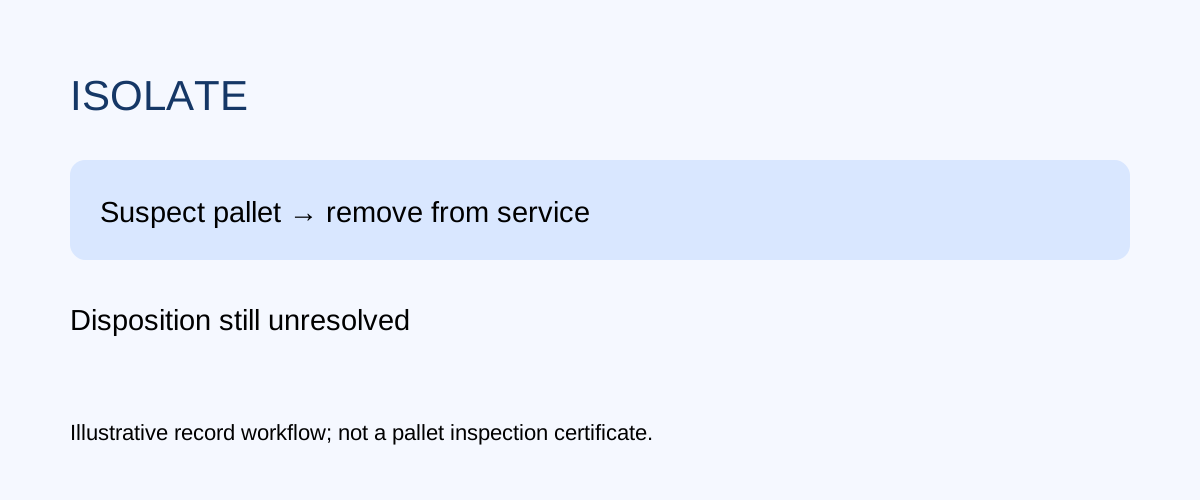
Separate the suspect pallet from service before deciding its disposition.
Identify who can decide on the repair
The same HSE section distinguishes pallets carrying a pool or owner trademark: it directs those needing repair back to the owner or its authorised representative in the first instance. Where ownership or trademark responsibility cannot be identified, it points to BS EN ISO 18613 for general guidance. That reference is a route to a repair specification, not evidence that this page has reproduced the standard's defect thresholds.
For a GMA pallet, record the actual design and intended handling method alongside ownership information. Do not turn an unidentified pallet into an approved reusable pallet by assigning it a grade yourself.
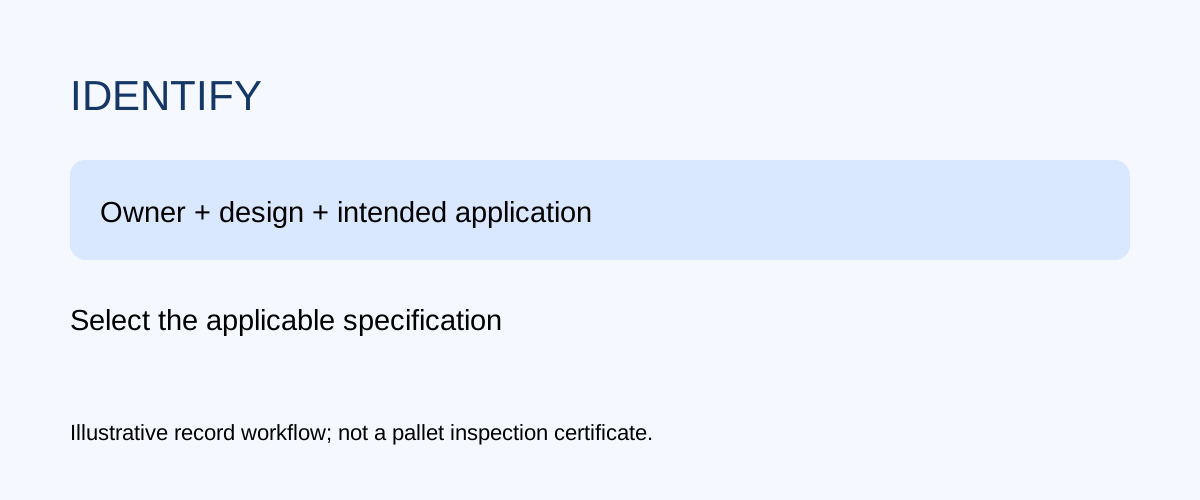
Record owner, pallet design and intended use before selecting a repair specification.
Do not transfer an EPAL threshold to a GMA pallet
EPAL's Euro Pallet QR page identifies missing boards, certain broken or splintered components and twisted blocks among its exchange defects. For that EPAL product, it gives a 10 mm protrusion limit for twisted blocks and requires licensed repair operations. Its repair provisions require dimensionally accurate components and a fit-for-use result after repair. Those are EPAL-system conditions; the numerical limit and licensing rule do not become universal GMA repair rules just because both products are wooden pallets.
A universal GMA numerical scrap threshold is not established here; obtain the specification for the actual pallet and application before deciding whether a defect is repairable.
Close the record before returning the pallet
My disposition worksheet keeps separate fields for the observed defect, the specification consulted, the repair or disposal decision and the person accepting the result. An empty decision field stays marked unresolved; it does not mean reusable. Likewise, a repair invoice is recorded as repair evidence, separately from the suitability decision for the next load. This worksheet is an editorial record format, not an inspection certificate or a replacement for the applicable repair standard.
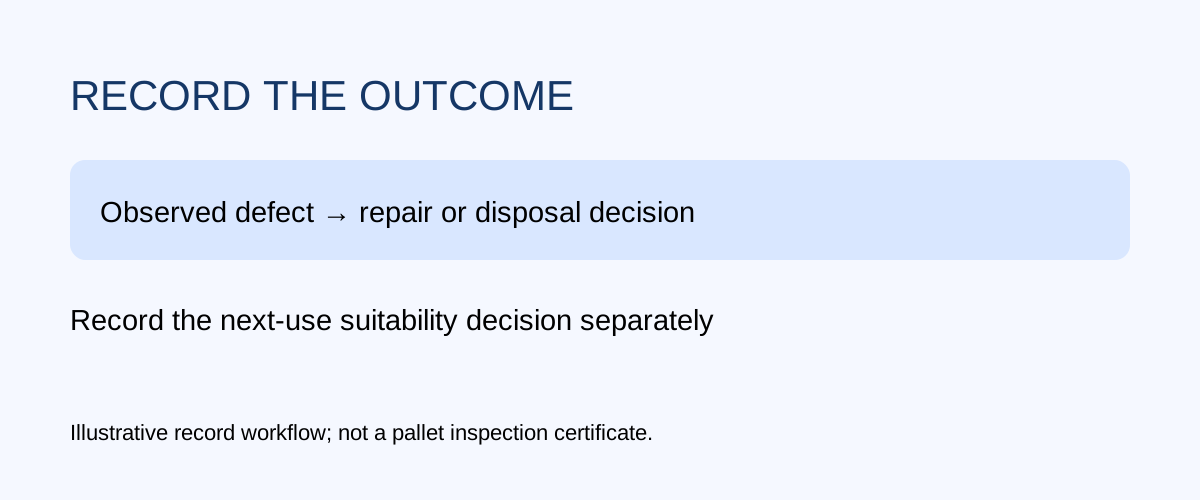
Repair work and approval for the next use are separate record fields.
Does a lower supplier grade mean I should scrap it?
The label alone does not document the defect or the repair specification used for this pallet. Record those facts before relying on a disposition decision.
Can a repaired pallet be used for any load?
HSE's suitability section ties the pallet design to its load, handling and storage conditions. A repair record therefore should not be presented as approval for an unspecified application.
A downloadable disposition record
The following worksheet and worked records are original editorial tools created for this page, not field observations or manufacturer approvals. Download the blank CSV worksheet and keep the defect photograph with the same record identifier. Our worksheet separates the quarantine location from the final disposition, so moving a pallet to a repair area cannot silently change its release status. The owner field has an explicit unknown option, while the repair authority field remains unresolved until a responsible party is identified. The specification field records both its document name and the component to which it applies, preventing a block criterion from being copied into a stringer decision without explanation. The proposed use field records the load and support arrangement rather than just the word warehouse. The repair evidence field stores the work record, while a separate acceptance field records who assessed suitability for that proposed use. The final state is one of hold, owner return, repair pending acceptance, released for recorded use, or disposal directed by the responsible party. These are labels in this worksheet, not standardised pallet grades.
Worked record A: an owner-marked pallet with a missing board
This hypothetical record begins with a missing board and a legible owner mark, with no repair authorisation attached. Enter the photograph reference under defect, mark the location as quarantine, and set the disposition to owner return pending instructions. Leave repair authority unresolved until the owner identifies the authorised route; a nearby supplier's willingness to replace a board does not fill that field. The next action in this record is contacting the owner, not assigning an invented repair threshold. If the owner supplies instructions, append them to the same record rather than deleting the original observation.
Worked record B: an unidentified pallet offered for rack storage
This hypothetical pallet has a visible split, no traceable design record, and a proposed use on rack beams. Record the split without declaring its numerical acceptability, and enter the planned rack support arrangement in the proposed-use field. Keep the record on hold while the responsible evaluator establishes the applicable design and repair specification. A seller's grade label belongs in the supplier-description field and leaves the missing specification field unresolved. If suitability cannot be established, this worksheet provides no release route; the responsible party must decide on return or disposal. That outcome records an evidence gap rather than claiming that every visible split requires scrapping.
Worked record C: repaired pallet, changed intended use
In this hypothetical case, the pallet returns with a repair invoice but the next assignment differs from the use recorded before repair. Attach the invoice as work evidence and keep the release field pending for the new assignment. Copy the old proposed use into the history field, then enter the new load and support arrangement as a separate entry. Do not overwrite the old acceptance with the new assignment, because doing so would erase what the earlier decision actually covered. The useful output is a traceable question for the evaluator: does the repaired design suit this recorded application? The worksheet cannot answer that engineering question by itself and does not calculate a safe load.
When does this process end in scrap?
In this workflow, disposal is entered only when the responsible party records that decision and its basis; unresolved evidence remains a hold. Record the reason as an applicable specification decision, an owner's instruction, or an inability to establish suitability, instead of writing only bad pallet. Keep a disposal instruction separate from a repair quote, since a quote describes proposed work rather than the final disposition. This preserves the difference between a pallet that was rejected for the recorded application and a universal claim about that pallet design.
Official sources
- HSE, Pallet safety PM15, fourth edition (2014): printed pages 2 and 6, Suitability and Pallet use and maintenance.
- EPAL Euro Pallet QR: Exchange criteria and Repair provisions, checked November 3, 2026.