Start with the shipment you will actually tender. Keep its description and measurement record together. A calculation answers a question about weight and space; it does not establish that the selected commodity provision applies. This page is a preparation guide, with a carrier-source comparison, rather than a replacement item-code database.
What to have beside the calculator
Describe the goods specifically enough to distinguish them from another commodity. Record their packaging and anything relevant to handling or stacking. Estes explains that classification considers density, handling, stowability and liability. Its guidance also asks shippers to identify commodities and their classifications on the bill of lading. These requirements explain why an unexplained class number is an incomplete starting point. Estes classification guidance
For measurements, use the packed unit rather than a product specification that leaves out packaging. Old Dominion tells shippers to measure the extreme dimensions and include packaging. Its published method calculates cubic feet from length, width and height in inches, divided by 1728, then divides shipment weight in pounds by cubic feet. The result is pounds per cubic foot, also called pcf. ODFL calculation method
Keep the units attached to the original measurements. If a supplier hands over a number without a unit or does not explain what was included, resolve that record before entering it. This is a proposed preparation practice, not a carrier-required form. Once the inputs are clear, use the site's NMFC calculator and public reference records for the calculation and its stated limitations.
NMFC class calculator: when density alone is not enough
A matching density result does not prove that a commodity is eligible for a density-based provision. Old Dominion describes its suggested result as an estimate and directs users to their product's NMFC guidelines. FedEx's published classification update introduces a thirteen-tier scale for applicable commodities, not an unconditional rule for everything that can be shipped. Confirm the item and its conditions before treating the density result as a classification instruction. FedEx classification update, page 1
Separate the item question from the arithmetic question. The first asks which commodity provision describes the goods as packed. The second asks whether the measurements and calculation are correct. Fixing a unit error will not resolve an uncertain commodity description. Conversely, finding an item record will not repair missing measurements. If you already have an identifier, the NMFC item and subitem reference lookup shows its limited coverage and individual sources; an absent record is not permission to invent a code.
What the carrier comparison can actually establish
Our comparison puts the three published density tables into pcf before comparing their bands. Their listed classes agree inside the intervals. A source table that expresses weight per cubic foot needs no reciprocal conversion. A volume-per-weight expression must instead be inverted before it represents pcf. These observations concern the representation being compared, not a newly discovered carrier pricing rule.
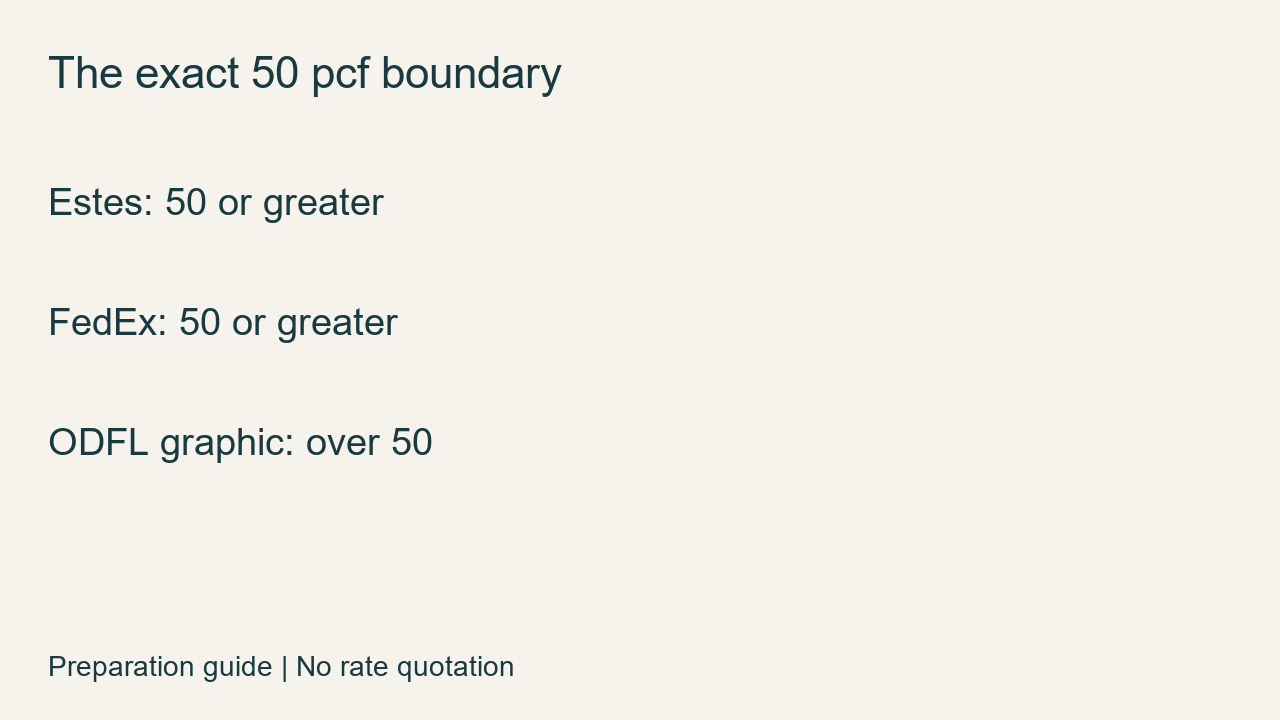
The exact 50 pcf boundary deserves a narrower statement. Estes and FedEx label their highest-density interval as including 50. The ODFL graphic prints "over 50" alongside a preceding interval labelled 35-50. That is different published boundary wording; the graphic does not explicitly settle inclusion at the exact point. It does not establish different shipment outcomes. ODFL official graphic

Preserve that uncertainty when you use the comparison. Do not choose a more favorable result by interpreting the graphic's punctuation yourself. Record which reference was used and seek confirmation of the applicable provision when a boundary matters. This review step is our proposed way of handling incomplete wording; it is not a claim that any carrier has approved a particular class for your shipment.
Freight class estimator: check the result before shipping
Compare the result with the same packed unit and the same commodity description that will appear in the shipping record. Check that the relevant item conditions have not been replaced by a generic calculator assumption. Keep the source and the unresolved question beside the result, so another person can see what has been established and what still needs confirmation.
Freight class and a minimum billing rule are separate questions. A density table alone cannot establish the full charge. Our source comparison did not obtain complete, matching minimum-charge and exception provisions across all carriers; this page therefore supplies no cross-carrier minimum-charge verdict or rate quotation. Do not turn an incomplete reference comparison into a promised invoice outcome.
Can this calculator choose my NMFC code?
Dimensions and weight alone do not identify the commodity provision. They support a density calculation. Identify the goods and confirm the applicable item conditions separately; if the public reference does not contain the record, its limitation remains a limitation.
Do the carrier tables prove a different result at exactly 50 pcf?
No. The comparison documents a difference in boundary wording, with the exact point unresolved by the ODFL graphic. It does not document a carrier's decision on a specific shipment. All carrier references on this page were checked on October 26, 2026; the FedEx document itself carries a May 2025 footer and discusses July 2025 changes.