The sum you can actually do
A bathroom scale reads to the pound and is usually within a pound. Twelve cartons at 17 pounds is 12 × 17 = 204 pounds. Add the pallet: 204 + 40 = 244 pounds.
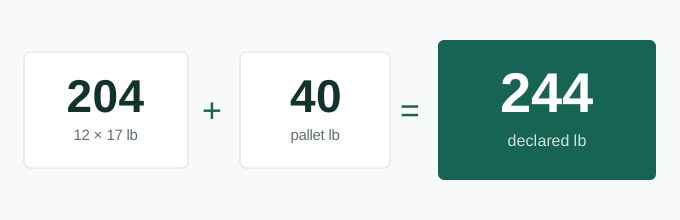
If the cartons are not identical, weigh three and average them, then multiply. Three weighings get you close; twelve get you closer; guessing gets you a reweigh.
Where the number drifts
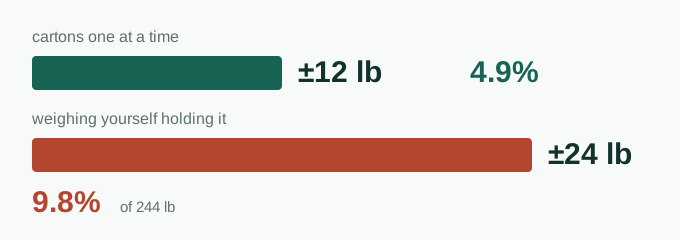
One pound of error per carton is twelve pounds on the load, and 12 ÷ 244 is 4.9 percent. That is already the size of the argument you will have at the terminal.
Weighing yourself holding the carton is worse. You weigh 160, then 177, and subtract: the scale's one pound of error applies twice, so each carton carries two pounds instead of one. Twelve cartons at two pounds is 24, and 24 ÷ 244 is 9.8 percent. The method feels more accurate because you never let go of the box, and it is twice as wrong.
Weigh the carton alone, on a flat floor, and write the number down as you go. Do not add them up in your head.
The pallet is the part people guess
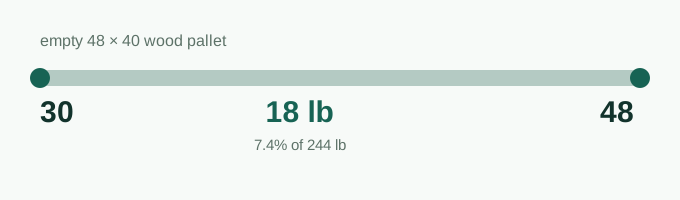
The empty pallet is not a constant. A wood stringer pallet at 48 × 40 runs 30 to 48 pounds depending on species and moisture, so the tare alone spans 18 pounds. On a 244-pound shipment that is 7.4 percent, and it is the one term in the sum that people fill in from memory. The ranges by pallet type are on the page about empty pallet weight, and the deck that carries them is 6.5 inches of the height as well.
Weigh the pallet too, or weigh two and average. It is one weighing and it removes the widest error in the whole calculation.
What happens to the number after you write it
The terminal scale is the one that gets billed. A carrier reweighs, compares the scale to the weight on the bill of lading, and bills the difference; the declared number is a claim you signed, not an estimate. That is why the 4.9 percent above matters more than it looks: it is the size of the gap that starts the conversation.
Two habits keep it small. Weigh the cartons one at a time, alone. Weigh the pallet and add it as its own line rather than folding it into a round number. Then the declared weight is a sum of measurements instead of a guess with a decimal point.
When the weight is not the problem
A light, bulky load does not get billed on the scale at all. If the cartons fill the pallet and weigh little, the volume takes over, and the arithmetic moves from pounds to cubic feet: 48 × 40 × 54 is 60.00 cubic feet, and 244 pounds over that is 4.07 pcf, which is class 175 territory. The dimensional weight page covers the same switch on the parcel side, where the divisor does the dividing for you.
So weigh it properly, then check whether weight is even the number that sets the price.